
Is a Desiccant Dehumidifier Cheaper to Run Than a Compressor One?
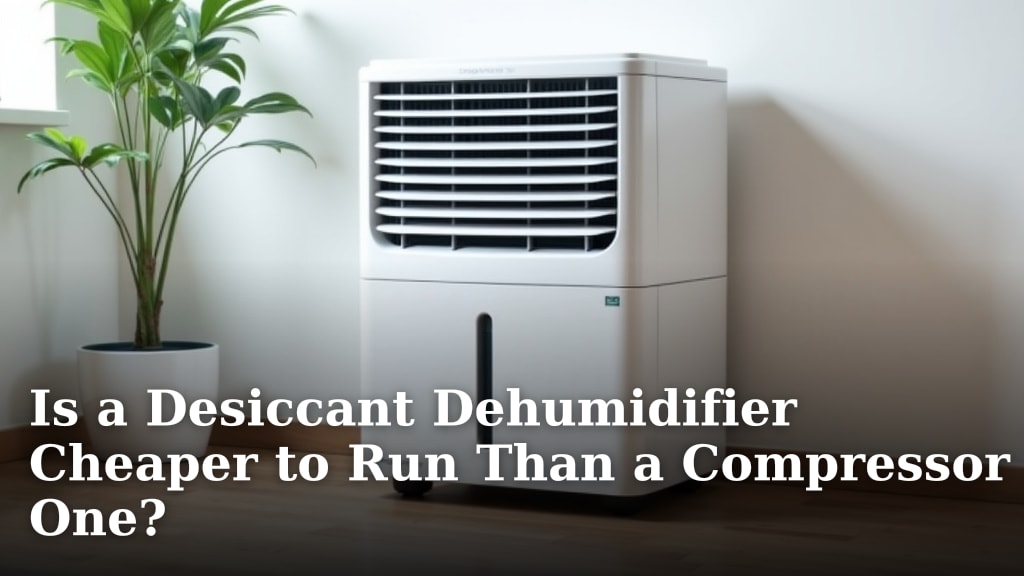
When you’re deciding between a desiccant and a compressor dehumidifier, you might wonder which one costs less to run. Generally, a desiccant dehumidifier is often cheaper to run than a compressor model, especially in cooler environments. This is because desiccant units work differently, avoiding the energy-intensive cooling process that compressor models rely on.
Both types of dehumidifiers aim to lower humidity in your home. Compressor models use refrigeration coils to cool air and remove moisture. Desiccant models use a special material to absorb water vapor. We found that the best choice for your wallet depends on your climate and the specific conditions you need to manage.
- Desiccant dehumidifiers can be cheaper to run.
- Compressor models work best in warmer, more humid areas.
- Desiccant models excel in cooler, damp spaces.
- Energy use varies based on room temperature and humidity levels.
Let’s break down the running costs and help you figure out which dehumidifier will be kinder to your electricity bill.
Running Costs: Desiccant vs. Compressor Dehumidifiers
So, is a desiccant dehumidifier cheaper to run than a compressor one? The short answer is: often, yes! But it really depends on where you live and what your home is like.
We’ve looked into how these two types of dehumidifiers work. This helps us understand why one might use more electricity than the other. Let’s get into the details of energy consumption and cost.
How Dehumidifiers Use Energy
The Compressor Model’s Power Needs
Think of a compressor dehumidifier like a small refrigerator. It has a compressor that chills a set of coils. When warm, moist air passes over these cold coils, the water vapor condenses into liquid. This water is then collected in a tank or drained away.
This cooling process is the big energy user. Compressors require a good amount of electricity to run. They are most efficient when the air is warm and humid. That’s when they can remove a lot of moisture with less effort.
Many guidelines point to compressor models using more energy in cooler conditions (Mayo Clinic). This is because the compressor has to work harder to reach the cold temperatures needed for condensation.
The Desiccant Model’s Energy Use
Desiccant dehumidifiers use a different approach. They have a rotating wheel filled with a moisture-absorbing material, often silica gel. This wheel spins through your home’s air, soaking up humidity. Then, it rotates into a heated section where the moisture is dried out of the desiccant material.
This heated air is then vented outside, or sometimes back into the room. The key here is that the primary energy use comes from a heating element. It’s generally less power-hungry than a compressor.
We found that desiccant units tend to use less energy overall. This is especially true when the ambient temperature is lower. They don’t rely on a power-hungry refrigeration cycle.
Comparing Energy Efficiency in Different Climates
Performance in Warm, Humid Environments
Compressor dehumidifiers are your best friend in warm, muggy climates. Places like Florida or the Gulf Coast have high humidity and warm temperatures year-round. In these conditions, a compressor model works efficiently.
It can pull a lot of water out of the air without the motor struggling. While it still uses electricity, its *efficiency* in removing moisture is high. This means you might get more bang for your buck in terms of water removed per kilowatt-hour.
So, if you live in a consistently hot and humid area, a compressor might be a good choice. It can handle the load effectively. Research suggests these units are best suited for temperatures above 60-65°F (CDC).
Performance in Cool, Damp Environments
Now, let’s talk about cooler, damp places. Think of basements, garages, or homes in cooler climates. This is where desiccant dehumidifiers shine. Even in unheated spaces, they can continue to work effectively.
A compressor unit would struggle in a cool basement. Its cooling coils might get too cold, leading to frost buildup. This reduces efficiency and can even damage the unit. Plus, the compressor motor itself would use a lot of power just to overcome the cold.
Desiccant models, on the other hand, are built for these conditions. The heating element is designed to work well even when it’s cold. Many experts say desiccant dehumidifiers are ideal for temperatures as low as 40°F (National Renewable Energy Laboratory).
This ability to function in cooler temps means they often don’t need to run as much in these scenarios. Less running time generally equals lower electricity bills. For your unheated garage or a damp cottage, a desiccant unit is often the more economical choice.
Understanding Wattage and Energy Bills
Wattage: The Key to Energy Use
When you’re comparing dehumidifiers, you’ll see a wattage rating. This number tells you how much power the unit uses when it’s running. A higher wattage means more electricity consumption.
Generally, desiccant dehumidifiers have a lower wattage rating than compressor models. However, there’s a catch. Some desiccant models vent the warm, moist air outside. This means they are constantly expelling heat.
Other desiccant models might recirculate this warm air back into the room. This can slightly increase the room’s temperature. It’s a trade-off for not needing to vent. This process might make the room feel warmer.
Calculating Your Running Costs
To figure out which is cheaper for *you*, you need to consider a few things. First, what’s the typical temperature and humidity in the space you want to dehumidify?
Second, how many hours per day will the unit likely run? And third, what do you pay for electricity in your area? You can find your electricity rate on your utility bill (usually in cents per kilowatt-hour, or kWh). To estimate costs, you’ll need to know your local electricity rate.
Here’s a simple way to estimate:
- Find the wattage of the dehumidifier.
- Convert wattage to kilowatts (divide by 1000).
- Multiply kilowatts by the number of hours the unit runs daily. This gives you daily kWh usage.
- Multiply daily kWh usage by your electricity rate (cents per kWh). This is your daily cost.
- Multiply daily cost by 30 for an estimated monthly cost.
Let’s look at an example. Suppose a desiccant dehumidifier uses 500 watts and a compressor uses 700 watts. Your electricity costs $0.15 per kWh. In a cool basement, the desiccant might run for 16 hours, while the compressor might struggle and run for 12 hours but at a higher peak wattage.
Desiccant: (500W / 1000) * 16 hours * $0.15/kWh = $1.20 per day. Compressor: (700W / 1000) * 12 hours * $0.15/kWh = $1.26 per day. In this *specific* scenario, the desiccant is slightly cheaper.
But if it was a hot, humid day and the compressor was in its element, it might run for only 8 hours. Compressor: (700W / 1000) * 8 hours * $0.15/kWh = $0.84 per day. The desiccant might still run 16 hours, costing $1.20. Now the compressor is cheaper.
Factors Beyond Initial Cost
Durability and Lifespan
When thinking about long-term costs, consider how long each type of unit might last. Compressor dehumidifiers have more moving parts, like the compressor motor and fan. These can wear out over time.
Desiccant units are generally simpler. They have a fan and a heating element, and the desiccant material itself. Many users report that desiccant models can be quite durable. They are often built to withstand colder temperatures without issue.
Maintenance Requirements
Both types require some basic maintenance. You’ll need to empty the water collection tank regularly or ensure a continuous drain is set up. The air filter on both types needs cleaning or replacing to keep the unit running efficiently.
For desiccant units, the desiccant material itself can degrade over many years. However, replacement is usually not needed for a very long time. The heating element is the main component to consider for wear.
We found that regular cleaning of filters is key for both. This ensures optimal performance and prevents premature wear. A clean filter allows air to flow freely, reducing strain on the motor.
Which Dehumidifier Is Your Wallet’s Best Friend?
Based on our research, here’s a quick summary to help you decide:
- Cooler temperatures (below 65°F): Desiccant models usually win for energy efficiency. They don’t rely on power-hungry cooling.
- Warmer temperatures (above 65°F): Compressor models can be more energy-efficient here. They excel at removing large amounts of moisture quickly.
- Basements and garages: Often cooler spaces, making desiccant units a good bet for lower running costs.
- Living areas: Typically warmer, so compressor models might be more effective and efficient depending on your climate.
- Noise: While not directly a cost, compressor units can be noisier due to the compressor. Desiccant units are often quieter.
- Portability: Both types come in various sizes. Lighter desiccant models might be easier to move if needed.
It’s really about matching the technology to your environment. A desiccant dehumidifier is often cheaper to run in cooler, damp conditions. A compressor dehumidifier is usually more cost-effective in warm, humid areas.
Conclusion
So, is a desiccant dehumidifier cheaper to run than a compressor model? Our research shows that desiccant units often have lower running costs, especially in cooler environments like basements or unheated garages. They avoid the energy-intensive cooling process that compressor models rely on. Compressor units tend to be more efficient in warmer, humid conditions where they can remove moisture faster.
Ultimately, the best choice for your electricity bill depends on your specific climate and the conditions in the space you need to dehumidify. Carefully consider where you’ll use the unit and its typical temperature to make the most cost-effective decision for your home.
Frequently Asked Questions
Do desiccant dehumidifiers use less electricity than compressor models overall?
Generally, yes. Desiccant dehumidifiers typically have a lower wattage rating and operate more efficiently in cooler temperatures, leading to lower overall electricity consumption in those conditions. Compressor models can use more power, especially when working hard in colder air.
Can a desiccant dehumidifier actually be more expensive to run in some situations?
Yes. If you live in a very warm and humid climate, a compressor dehumidifier might be more efficient for your needs. They excel at removing large amounts of moisture quickly in high heat, potentially running for fewer hours and costing less than a desiccant model in that specific scenario.
How does the temperature of the room affect running costs?
Temperature is key. Desiccant units work well in cooler temps because their heating element is less energy-intensive than a compressor trying to cool coils in cold air. Compressor units are more efficient when it’s warm, as the cooling process works better.
Are desiccant dehumidifiers better for basements and garages?
Often, yes. Basements and garages tend to be cooler and damper spaces. Desiccant dehumidifiers are built to perform effectively in these lower temperatures, making them a more energy-efficient and cost-effective choice for these areas compared to compressor models.
What’s the best way to estimate the running cost for my chosen dehumidifier?
To estimate costs, you’ll need the dehumidifier’s wattage, how many hours you expect it to run daily, and your local electricity rate per kilowatt-hour (kWh). You can then calculate daily and monthly expenses to see which type aligns better with your budget.
