Best 70-Pint Dehumidifiers for Basements: Top 9 Picks (November 2026)
The best 70-pint dehumidifiers for basements include the Waykar 120 Pints 6000 Sq. Ft for very damp large basements, the Waykar 6000 Sq.Ft Energy Star Dehumidifier for quiet large-basement operation, and the Waykar 80 Pints 5000 Sq. Ft for large finished basements.
On this page (5 sections)
The best 70 pint dehumidifier for basement use is the Waykar 120 Pints 6000 Sq. Ft.
It has the highest stated capacity in this group, continuous-drain support and a 30%–80% humidity range.
A 70-pint search often brings up 80-pint and 120-pint units because modern ratings are reported under different test conditions. The number alone does not tell you how much water a machine removes in your cooler basement.
If you're unsure how much capacity your room needs, start with What Size Dehumidifier Do I Need for My Basement?. For smaller capacity choices, compare these Top 7 Pint Dehumidifier For Basement picks and the alternatives in another Top 7 Pint Dehumidifier For Basement guide.
Our picks at a glance
-
1
-
2
 Best for quiet large-basement operation
Waykar 6000 Sq.Ft Energy Star Dehumidifier
9.7/10 our score
See it on Amazon -
3
- 4
 Check it
boglvr 6000 Sq.Ft. Energy Star Dehumidifier
Best for app and voice control - 5
 Check it
yaufey 80 Pint Dehumidifier for Basement
Best for flexible large-room settings - 6
 Check it
Kesnos 80 Pints Energy Star Dehumidifier
Best for visible humidity monitoring - 7
 Check it
KNKA Energy Star 5500 Sq.Ft Dehumidifier
Best for basement-mode flexibility - 8
 Check it
Midea 50 Pint Dehumidifier for Basement
Best for moderate basement moisture - 9
 Check it
DuraComfort 65 Pints Max Dehumidifier for Basement
Best for smaller damp basements
The best 70-pint dehumidifiers for basements
The best choice depends on basement size, moisture level, drainage and how closely the stated test condition matches your room. For lighter moisture needs, compare basement moisture absorbers.
The two Waykar 120-pint models lead for large, damp spaces, while the smaller models suit moderate moisture.
We compared stated capacity, coverage, humidity control, drainage, noise claims and basement-focused features. Our score weighs specs, features and buyer feedback against what you're shopping for.
| Product | Best for | Rated capacity | Stated coverage | Drainage | Our score |
|---|---|---|---|---|---|
| Waykar 120 Pints 6000 Sq. Ft | very damp large basements | 120 pints per day | Up to 6,000 sq. ft. | 4.3 L tank and included hose | 9.7 |
| Waykar 6000 Sq.Ft Energy Star Dehumidifier | quiet large-basement operation | 120 pints per day | Up to 6,000 sq. ft. | Removable tank and included hose | 9.7 |
| Waykar 80 Pints 5000 Sq. Ft | large finished basements | 80 pints per day | Up to 5,000 sq. ft. | 4.3 L tank and included hose | 9.6 |
| boglvr 6000 Sq.Ft. Energy Star Dehumidifier | app and voice control | 100 pints per day maximum | Up to 6,000 sq. ft. | 4.28 L tank and included hose | 9.5 |
| yaufey 80 Pint Dehumidifier for Basement | flexible large-room settings | 80 pints per day | Up to 5,500 sq. ft. | 1.06-gallon tank and included hose | 9.4 |
| Kesnos 80 Pints Energy Star Dehumidifier | visible humidity monitoring | 80 pints per day | Up to 6,000 sq. ft. | 1.06-gallon tank and included hose | 9.3 |
| KNKA Energy Star 5500 Sq.Ft Dehumidifier | basement-mode flexibility | 80 pints maximum; 56 pints at 86°F and 80% RH | Up to 5,500 sq. ft. | 1.45-gallon tank and 6.56 ft hose | 9.2 |
| Midea 50 Pint Dehumidifier for Basement | moderate basement moisture | 50 pints per day | Up to 4,500 sq. ft. | 1.6-gallon tank and hose connection | 8.7 |
| DuraComfort 65 Pints Max Dehumidifier for Basement | smaller damp basements | 65 pints maximum; 25-pint DOE capacity | Up to 3,500 sq. ft. | 6-pint tank and included hose | 8.4 |
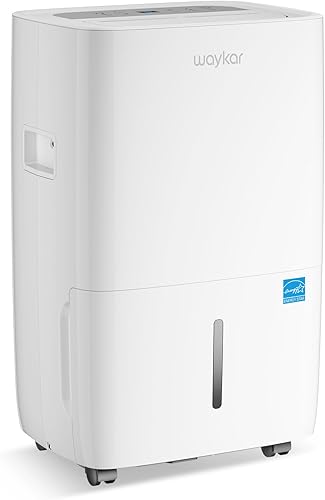
Waykar 120 Pints 6000 Sq. Ft: Best for very damp large basements
- 120 pints per day at 95°F and 90% RH
- Up to 6,000 sq. ft.
- 30%–80% humidity control
- 90° auto swing airflow
- Tank and drain hose
This Waykar combines the largest stated capacity here with 30%–80% humidity control and 90° auto swing airflow. It suits a large or persistently damp basement where continuous drainage matters.
Pros
- Highest stated pint capacity
- 30%–80% humidity range
- Auto swing airflow
- Included drain hose
Cons
- Large capacity may be more than a small basement needs
- Coverage claims use controlled rating conditions
The Waykar 120 Pints 6000 Sq. Ft is the strongest overall pick for a very damp or large basement.
Its maximum rating is 120 pints per day at 95°F and 90% RH, and its stated coverage reaches 6,000 sq. ft.
The 30%–80% humidity range gives you more control than models that stop at 40%. Its 90° auto swing airflow can spread dry air across more of the room, while the included hose supports continuous gravity drainage.
The 4.3 L tank remains available when a drain is not practical. Auto defrost, overload protection and a 24-hour timer also support extended operation.
Pick it when the basement is large, damp or connected to other areas. Confirm that the cabinet, drain path and power connection fit your installation before ordering.
Waykar 6000 Sq.Ft Energy Star Dehumidifier: Best for quiet large-basement operation
- 120 pints per day at 95°F and 90% RH
- Up to 6,000 sq. ft.
- 40 dB low-speed claim
- Auto Comfort mode
- Continuous drainage
The second Waykar 120-pint model adds Auto Comfort mode, built-in mobility features and a stated 40 dB low-speed level. It fits buyers who want large stated capacity with quieter operation.
Pros
- 120-pint stated capacity
- Auto Comfort mode
- 40 dB low-speed claim
- 3 fan speeds
Cons
- Maximum sound level is higher than the low-speed figure
- Large cabinet needs careful placement
This Waykar is another 120-pint choice, with a stated capacity of 120 pints per day at 95°F and 90% RH. Its standout feature is Auto Comfort mode, which adjusts operation around changing room conditions.
The unit has 3 fan speeds, continuous-drain support, built-in wheels and a handle. Waykar gives a 40 dB low-speed claim, although the maximum stated sound level is higher.
Choose this model if you want large stated capacity with quieter low-speed operation and automatic comfort control. It is a better fit for a basement near a bedroom or work area than a unit with fewer control options.
Waykar 80 Pints 5000 Sq. Ft: Best for large finished basements
- 80 pints per day at 95°F and 90% RH
- Up to 5,000 sq. ft.
- 30%–80% humidity control
- 90° auto swing
- Continuous drainage support
This 80-pint Waykar is a strong match for a large basement that does not need a 120-pint unit. Its wide humidity range, auto swing and drain hose support long operating periods.
Pros
- 80-pint stated capacity
- 30%–80% humidity range
- Auto swing airflow
- Energy Star certification
Cons
- The 80-pint rating uses warm, humid test conditions
- Tank still needs emptying if gravity drainage is unavailable
The Waykar 80 Pints 5000 Sq. Ft is the best middle ground for a large basement that does not need a 120-pint machine.
It removes up to 80 pints per day at 95°F and 90% RH and covers up to 5,000 sq. ft.
The 30%–80% humidity range helps you set a target for damp storage areas or a finished basement. Its 90° auto swing feature spreads airflow, while the tank and included hose support manual or continuous drainage.
The stated 42 dB operation claim may appeal to buyers who spend time downstairs. Keep in mind that its 80-pint number comes from warm, humid conditions, not every basement climate.
boglvr 6000 Sq.Ft. Energy Star Dehumidifier: Best for app and voice control
- Up to 100 pints per day at 95°F and 90% RH
- Tuya and Smart Life app control
- 30%–80% humidity settings
- Basement mode
- Continuous drainage
The boglvr adds Wi-Fi app control, Alexa compatibility and a dedicated Basement mode. It suits a basement where remote scheduling and humidity adjustments are more useful than simple controls.
Pros
- App and voice control
- Basement mode
- 30%–80% settings
- 45 dB maximum-speed claim
Cons
- Smart features depend on app setup
- The maximum rating is not the same as a 70-pint test rating
The boglvr is the best smart-control pick. It supports Tuya and Smart Life apps, Alexa voice control, 3 fan speeds and a dedicated Basement mode.
Its maximum moisture-removal claim is 100 pints per day at 95°F and 90% RH, or 60 pints at 86°F and 80% RH. That second figure is useful because cooler conditions are closer to many basements.
The 30%–80% setting range, 24-hour timer and 7-day planning support scheduled operation. A 4.28 L tank and included hose give you two drainage choices.
Choose it when remote control matters. If you prefer simple physical controls, one of the Waykar or Kesnos models may be easier to manage.
yaufey 80 Pint Dehumidifier for Basement: Best for flexible large-room settings
- 80 pints per day at 95°F and 90% RH
- Up to 5,500 sq. ft.
- 4 operating modes
- 3 fan speeds
- 1.06-gallon tank and hose
Yaufey gives you 4 modes, 3 fan speeds and adjustable 30%–80% humidity control. Its stated 5,500 sq. ft. coverage makes it suitable for a large basement or connected living area.
Pros
- 4 operating modes
- 3 fan speeds
- 30%–80% humidity range
- Auto restart
Cons
- Coverage is a maker-stated maximum
- A standard garden hose is not included
Yaufey suits a large basement where you want more control over daily operation. It removes up to 80 pints per day at 95°F and 90% RH and states coverage up to 5,500 sq. ft.
Four operating modes and 3 fan speeds let you adjust the unit for different rooms. The 30%–80% humidity range, temperature and humidity sensors, 24-hour timer and auto restart add useful control.
The 1.06-gallon tank shuts the unit off when full. For longer use, connect the included 3.28 ft hose to a downward-sloping drain path.
Kesnos 80 Pints Energy Star Dehumidifier: Best for visible humidity monitoring
- 80 pints per day at 95°F and 90% RH
- Up to 6,000 sq. ft.
- Front humidity display
- MIRAGE sleep mode
- Continuous drainage
The Kesnos puts humidity readings on the front and can turn the display off in MIRAGE sleep mode. It fits buyers who want quick status checks without keeping a bright panel on.
Pros
- Front humidity display
- Sleep display-off mode
- Auto defrost
- Memory restart
Cons
- Only 2 fan speeds
- Coverage and capacity vary with room conditions
Kesnos is the best choice if you want to see humidity at a glance. Its front display shows room humidity, while MIRAGE Sleep Mode turns the display off while the unit continues running.
The unit removes up to 80 pints per day at 95°F and 90% RH and states coverage up to 6,000 sq. ft. Auto defrost, memory restart, safety lock and overload protection support regular basement use.
The 1.06-gallon tank and included 3.3 ft hose cover manual and continuous drainage. Its 2 fan speeds are simple, but less flexible than models with 3 speeds.
KNKA Energy Star 5500 Sq.Ft Dehumidifier: Best for basement-mode flexibility
- Up to 80 pints per day at 95°F and 95% RH
- 56 pints per day at 86°F and 80% RH
- Up to 5,500 sq. ft.
- 1.45-gallon tank
- 40–45 dB claim
KNKA clearly gives both a hot, humid maximum and a lower typical-condition figure. That makes it useful for buyers who want to compare capacity claims with a basement-like test condition.
Pros
- Shows two capacity conditions
- Long included drain hose
- 40–45 dB claim
- Auto, Dry and Setting modes
Cons
- The typical-condition figure is below 70 pints
- External tank is sold separately
KNKA gives one of the clearest capacity comparisons in this group. It states 80 pints per day at 95°F and 95% RH, but 56 pints per day at 86°F and 80% RH.
That lower figure shows why a maximum rating should not be treated as a constant basement output. KNKA also includes Auto, Dry and Setting modes, with adjustable humidity from 30% to 80%.
The 1.45-gallon tank is larger than several competing models, and the 6.56 ft hose gives more routing flexibility. An optional external tank is sold separately.
Midea 50 Pint Dehumidifier for Basement: Best for moderate basement moisture
- 50 pints per day
- Up to 4,500 sq. ft.
- Wi-Fi control
- 49 dBA low-mode claim
- Continuous drainage
Midea is the smaller-capacity choice for a moderately damp basement. Wi-Fi control, 360° wheels and a 49 dBA low-mode claim add convenience when 70 or 80 pints would be excessive.
Pros
- Wi-Fi and voice control
- 4,500 sq. ft. stated coverage
- 49 dBA low-mode claim
- Automatic restart after emptying
Cons
- 50-pint rating is below the larger picks
- Drain hose is not included
Midea is the best smaller-capacity option for a moderately damp basement. It removes up to 50 pints per day and states coverage up to 4,500 sq. ft.
Wi-Fi control, Alexa and Google Assistant compatibility let you adjust the unit remotely. The 49 dBA low-mode claim, 360° wheels and automatic stop when the tank is full add everyday convenience.
Midea supports continuous drainage through a standard hose connection, but the hose is not included. Choose it when 50 pints is enough and you want smart controls without the larger capacity of the other picks.
DuraComfort 65 Pints Max Dehumidifier for Basement: Best for smaller damp basements
- 65 pints maximum at 90°F and 80% RH
- 25-pint DOE capacity
- Up to 3,500 sq. ft.
- Continuous drainage
- Adjustable humidistat
DuraComfort shows why capacity labels need context: its maximum is 65 pints, while its DOE capacity is 25 pints. It suits a smaller damp basement where the lower rated capacity is enough.
Pros
- Clear maximum and DOE figures
- Included drain hose
- Adjustable humidistat
- Up to 3,500 sq. ft.
Cons
- Not a true 25-pint DOE unit
- Smallest stated coverage here
DuraComfort is useful for a smaller basement where a full 70-pint-class unit may be unnecessary. Its capacity is stated as 65 pints maximum at 90°F and 80% RH, while its DOE capacity is 25 pints.
That difference is important. The 65-pint maximum is not the same as a 70-pint rating under identical conditions, so compare it with your room's moisture level rather than the headline number.
The unit covers up to 3,500 sq. ft., includes a drain hose and uses an adjustable humidistat. It is the most suitable pick here for moderate dampness and a smaller space.
How do capacity ratings compare in a basement?
A 70-pint label usually describes moisture removal under a particular temperature and relative humidity. A warmer, wetter test condition produces a higher daily pint number than a cooler basement condition.
The KNKA data makes this clear: 80 pints at 95°F and 95% RH becomes 56 pints at 86°F and 80% RH. The boglvr also drops from 100 pints at 95°F and 90% RH to 60 pints at 86°F and 80% RH.
Use the rating as a comparison point, not a promise of constant daily output. Room size, air leakage, laundry, seepage, condensation and door position all affect actual moisture removal.
What drainage setup works best downstairs?
Continuous gravity drainage is usually the easiest setup for a basement with a nearby floor drain or sump area. Place the unit high enough for the hose to slope downward, but keep it stable and accessible.
A tank is still useful when the drain is too far away or sits higher than the outlet. Every model here has a tank, and the larger units also support an included hose.
For more setup advice, read How to Use a Dehumidifier in a Basement?. You can also compare another Top 7 Pint Dehumidifier For Basement list if your room is smaller than the coverage ranges here.
What features matter beyond pint capacity?
Humidity control, auto defrost, drainage and restart behavior matter more than a large number alone. A 30%–80% range gives you more adjustment, while auto defrost helps the unit keep operating in cooler conditions.
A washable filter reduces recurring replacement needs, but it still needs regular cleaning. Wheels and handles help when you need to move the unit between rooms, and a display-off mode can reduce light in a nearby sleeping area.
Energy Star certification is another useful comparison point. You can review the current program information at ENERGY STAR.
Which 70-pint dehumidifier should you choose?
Choose the Waykar 120 Pints 6000 Sq. Ft for a very damp, large basement and the strongest stated capacity.
Choose the second Waykar 120-pint model if Auto Comfort mode and quieter low-speed operation matter more.
Pick the Waykar 80-pint, Yaufey, Kesnos or KNKA for a large basement where an 80-pint-class unit is enough. Choose boglvr for app control, Midea for moderate moisture with smart features, and DuraComfort when its lower DOE capacity matches a smaller space.
The best 70 pint dehumidifier for basement use is the one whose rated conditions, drainage setup and coverage fit your room. Measure the available space, confirm the hose route and use a separate hygrometer to check the result.
Our top 3 picks at a glance
-
1
-
2
Best for quiet large-basement operation
Waykar 6000 Sq.Ft Energy Star Dehumidifier
9.7/10 our score
See it on Amazon -
3
Frequently asked questions
What is the best 70 pint dehumidifier for a basement?
The best 70 pint dehumidifier for a basement depends on the test condition and room size. The Waykar 120 Pints 6000 Sq.
Ft is the strongest large-capacity choice here, while the Waykar 80 Pints 5000 Sq.
Ft suits a large basement with slightly lower stated capacity.
Is an 80-pint dehumidifier better than a 70-pint model?
An 80-pint dehumidifier is not automatically better because pint ratings use specific temperature and humidity conditions. Compare the stated test conditions, coverage, drainage options and humidity controls.
An 80-pint model may fit a large basement, but a smaller unit can be enough for moderate moisture.
Why do dehumidifiers have different pint ratings?
Pint ratings change with temperature and relative humidity. A unit may remove more water at 95°F and 90% RH than at 86°F and 80% RH.
KNKA, for example, gives both an 80-pint maximum and a 56-pint figure under a cooler, less humid condition.
Do basement dehumidifiers need a drain hose?
A drain hose is useful when you want continuous gravity drainage and have a nearby floor drain or sump location. Otherwise, you can empty the tank manually.
Check that the hose path slopes downward, and keep the tank and full-tank shutoff available as backup.
What humidity should a basement dehumidifier target?
A basement dehumidifier commonly works around 45%–55% relative humidity, but the correct setting depends on condensation and the room's conditions. Use a separate hygrometer to confirm the reading, keep doors and windows closed while running, and avoid drying the space more than needed.