Pedestal vs Submersible Sump Pump: Which Should You Choose? (November 2026)
Choose a pedestal pump for a narrow pit and easy access, and a submersible pump for a standard pit and quieter submerged operation. In this pedestal vs submersible sump pump comparison, pit diameter, water depth and how often you check the pump decide the better fit.
On this page (12 sections)
- Pedestal vs submersible sump pump: the quick verdict
- The two types side by side
- Pit space: where pedestal and submersible really differ
- Access and service: the pedestal advantage
- Noise and daily use in a finished basement
- Power, flow and lift: read the numbers the same way
- Debris, clogging and switch design
- Materials and build: cast iron, steel and thermoplastic
- Which submersible here fits which buyer
- Who should buy pedestal, and who should buy submersible
- Set up either type so it runs for years
- Final verdict on pedestal vs submersible sump pump
Choose a pedestal for narrow pits and easy service access, and a submersible for standard pits and quieter submerged running. The pedestal vs submersible sump pump choice starts with your pit, not with horsepower.
We compared the specs below, which are all submersible models, to show what a submersible gives you in size, flow and construction.
A pedestal pump puts the motor on a stand above the pit. Only the impeller end sits down in the water.
A submersible pump puts the whole unit in the pit. That one layout difference drives space, noise, cooling and service.

Pedestal vs submersible sump pump: the quick verdict
Pick pedestal if the pit is too narrow for a submersible or you want the motor out of the water. Pick submersible if the pit is 11 in or larger and you want a sealed unit that runs under water.
Our top submersible here is the WAYNE CDU790 for compact pits. It weighs 16.4 lb, measures 9 x 6.5 x 11.5 in, and uses a vertical float switch.
That switch moves beside the pump instead of tipping out to the side.
A pedestal still wins on access. You can see the motor and check the stand without lifting a pump out of water.
A submersible wins on pit use. It runs submerged, which helps with cooling and sound.
For a sump pump for basement use, measure first. Check pit diameter, pit depth, discharge height and lid clearance.
Those four numbers will rule out more pumps than brand or horsepower.
The two types side by side
The table shows the real trade: pedestal saves pit width, submersible saves noise and space above the pit. Use it with your measurements, not as a general ranking.
| Point | Pedestal sump pump | Submersible sump pump |
|---|---|---|
| Motor position | Above the pit on a stand | In the pit, under water |
| Pit width needed | Narrow pits can work | Wayne models here need 11 in or larger |
| Service access | Motor is above water | Lift the whole pump to service |
| Noise | Motor hum can carry in the room | Water dampens motor sound |
| Cooling | Air cooling above the pit | Water cooling around the motor |
| Float switch | Often tethered or vertical | Often vertical, as on the Wayne models |
| Flow here | Varies by model | 4,500 to 5,490 GPH in this group |
A pedestal pump also leaves the motor dry, which helps inspection. You can check for leaks or loose cords without handling a wet unit.
A submersible hides those signs until you lift it.
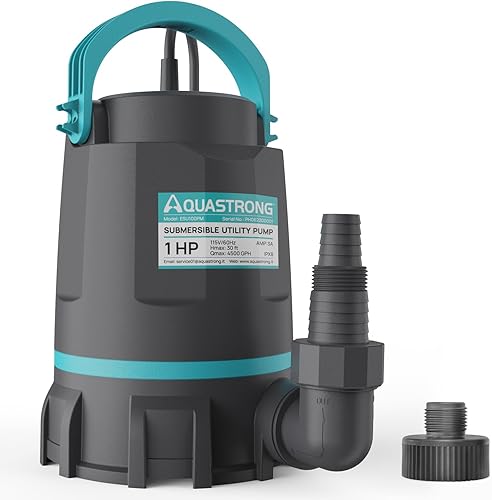
The submersible models here show why size matters. The AQUASTRONG measures 6.3 x 9.85 x 11.03 in.
The Zoeller measures 9.96 x 7.95 x 10.16 in. Small changes in body width and float position can decide fit.
Pit space: where pedestal and submersible really differ
Pedestal fits narrow pits; submersible needs diameter for the body plus switch travel. That is the most common reason buyers switch types.
A pedestal stand is slim and the motor sits high, so the pit only needs to clear the lower pump end. That helps older pits and narrow necks, and leaves room for a backup pump beside the main pump.
Compare battery backup sump pump combos if you need a second pump for outages. A submersible needs a wider pit.
Wayne designed the CDU790 and CDU980E for 11 in diameter or larger pits. The CDU790 is 6.5 in wide, but the pit still needs space for the float switch and water flow around the body.
A submersible sits below the floor, so the lid and water dampen sound. A pedestal motor sits at or above floor level.
Check lid clearance too, since a pedestal adds height above the pit and a submersible adds height inside it. Our shallow sump pump with float switch guide helps when that height stack is tight.
Access and service: the pedestal advantage
Choose pedestal if you want to check the motor without pulling a wet pump from the pit. Choose submersible if you can lift the pump on a service schedule and prefer a sealed unit.
With a pedestal, the motor, cord connection and stand stay dry and visible. You can check the power plug and look for corrosion in minutes.
That access also makes replacement parts simpler. Our guide to best pedestal sump pump parts covers the spares owners often keep for this layout.
With a submersible, service means removing the lid, lifting the pump and handling a wet, heavy unit. The Zoeller M53 weighs 21 lb.
The Wayne CDU790 weighs 16.4 lb.
The AQUASTRONG weighs 8.5 lb, which makes it the easiest of these four to lift by hand. Submersible service is not hard.
It is just less frequent and less visual.
You check the float switch, clear the intake and inspect the discharge connection on a set schedule. If you rarely open the pit, a pedestal gives you more chances to spot trouble early.
Noise and daily use in a finished basement
A submersible usually runs quieter in a finished basement because the motor is under water and below the floor. A pedestal motor can be louder because it sits in the room air.
Wayne describes the CDU790 and CDU980E as ultra-quiet. That claim fits the physics of a sealed motor under water.
The lid, pit walls and water all sit between the motor and the room. A pedestal has no such barrier.
Noise is not only the motor. The discharge check valve can thud when it closes.
A loose discharge pipe can hum against a joist. A float switch that chatters can cause short cycles.
Fix those, and either type can run with less disturbance.
If the basement is unfinished, noise matters less. If the pit sits under living space, a submersible has a clear edge.
Keep the lid sealed and the discharge pipe secured on either type.
Our best submersible sump pump guide breaks down these models further. Use it after you confirm pit size, since a quiet pump that does not fit helps no one.
Power, flow and lift: read the numbers the same way
Compare flow at a stated lift, not headline gallons alone. A pump rated at low lift may move far less at your discharge height.
In cold climates, a sump pump freeze guard can help keep the discharge outlet clear. The Wayne CDU980E moves up to 5,490 GPH at 92 GPM.
The Wayne CDU790 moves up to 4,600 GPH at 63 GPM. The AQUASTRONG moves 4,500 GPH at 5 ft at 75 GPM.
The Zoeller M53 does not state a flow rate in the specs checked. Horsepower tells only part of the story.
The AQUASTRONG is 1 HP and lifts up to 30 ft. The Wayne CDU980E is 3/4 HP, while the Wayne CDU790 and Zoeller M53 are 1/3 HP.
Buy for your worst case. For fast rising groundwater, the CDU980E gives more headroom.
A battery backup sump pump system can help if the primary pump loses power. A 1/3 HP model may suit light, steady inflow.
See our superior sump pump reviews and wayne sump pump reviews to compare motor sizes.
Debris, clogging and switch design
Top suction and a vertical float switch help in debris prone pits. Bottom suction drains lower but needs more clearing.
The Wayne CDU790 and CDU980E use top suction. Wayne says this limits air lock and cuts clogging from debris at the pit bottom.
The CDU790 also has a float guard to protect the switch from hang ups. Its integrated vertical float switch was tested to 1 million cycles.
The AQUASTRONG uses bottom suction. It removes water down to 1/5 in from the surface and handles solids up to 1/5 in.
That design suits window wells and shallow water removal. Debris at the pit bottom can reach the intake sooner, so clearing matters more.
The Zoeller M53 uses a non-clogging vortex impeller to move solids without tight passages. It also uses a float activated switch and a durable cast iron switch case.
A pedestal motor stays dry, but its lower end still sits in pit water and can clog. Keep the pit clean on either type and test the switch by lifting it gently and letting it drop.
Materials and build: cast iron, steel and thermoplastic
Cast iron and steel suit permanent pit duty; thermoplastic suits lighter, portable work. Match the build to how long the pump will stay in the pit.
The Wayne CDU790 has a corrosion-resistant epoxy coated steel motor housing, stainless steel fasteners and a cast-iron volute. The CDU980E uses cast iron and stainless steel.
The Zoeller M53 uses a cast iron switch case, motor and pump housing with a plastic base. Those builds favor long pit service and quiet operation.
The AQUASTRONG uses a reinforced engineering thermoplastic casing. Thermoplastic resists corrosion and abrasion, and it keeps the AQUASTRONG light at 8.5 lb.
Cast iron adds weight and a denser feel, which can help a pump stay put in the pit.
Warranty lines up with the build. Wayne backs the CDU790 for 3 years and the CDU980E for 5 years.
Both are assembled in the USA, according to Wayne. Check the exact terms for your model before you buy, since warranty terms can change.
Which submersible here fits which buyer
Pick the CDU790 for compact pits, the AQUASTRONG for high lift, the CDU980E for heavy inflow and the Zoeller M53 for solids. Each solves a different pit problem.
The WAYNE CDU790 1/3 HP Submersible Water Pump suits 11 in or larger pits and steady inflow. It measures 9 x 6.5 x 11.5 in and lifts up to 20 ft.
Its top suction and vertical float switch suit narrow pits where a tethered switch would bind. The AQUASTRONG 1 HP suits buyers who need lift.
It lifts up to 30 ft and includes a 1-1/4 in discharge with adapters for 3/4, 1 and 1-1/4 in hose. Its bottom suction drains to 1/5 in.
That suits window wells, hot tubs and flooded areas, not only permanent pits. The Wayne CDU980E suits heavy rain or snow melt.
At 5,490 GPH it leads this group on flow, with a 3/4 HP motor, cast iron and stainless steel build and 5-year warranty. The Zoeller M53 suits grit and solids.
Its vortex impeller, cast iron housing and float activated switch suit debris prone pits. The LED power plug helps you check for power.
It lifts up to 19.25 ft and weighs 21 lb, so plan for the lift.
Who should buy pedestal, and who should buy submersible
Buy pedestal for narrow pits and dry service. Buy submersible for standard pits and quieter running.
Most buyers with a standard 11 in or larger pit will land on submersible.
Buy pedestal if your pit is narrow, your lid clearance is odd, or you want to inspect the motor often. Buy it if a backup pump needs room beside the main pump and the pit cannot spare width for two submersible bodies.
Buy submersible if your pit is 11 in or larger, the basement is finished, and you want the motor below floor level. Buy it if noise matters and you want water cooling around the motor.
Moisture control is part of the same system, so dry the air after you pick a pump. Our Best Dehumidifier For Basement With A Sump Pump guide pairs dehumidifiers with sump pits.
Our Best Dehumidifier With A Pump guide covers models that move condensate without a separate pump.
Set up either type so it runs for years
Set the pump level, secure the discharge, test the switch and keep the pit clean. Those steps matter more than brand for reliability.
Start with the pit. Remove grit, sludge and debris, and check the pit is level with the pump sitting stable.
A pump that tilts can bind its float switch or strain the discharge connection.
Next, secure the discharge pipe. Use a fitting check valve, support the pipe on its run, and keep it from vibrating against framing.
A loose pipe can fail at the joint or wake the house each cycle.
Test the switch before closing the lid. Lift it to the on point, hold it at the off point, then let it drop.
Watch for contact with the pit wall, discharge pipe or lid. Wayne vertical switches need less side room, but still need clear travel.
Keep power safe and visible. Use a suitable outlet, keep cords off the pit floor where possible, and check the plug during storms.
The Zoeller LED plug shows power at a glance. Test the pump after every heavy rain.
Final verdict on pedestal vs submersible sump pump
For most standard pits, a submersible is the better buy; for narrow pits and easy service, a pedestal is the better buy. In this pedestal vs submersible sump pump debate, pit diameter and buyer habit beat brand loyalty.
If your pit is 11 in or larger and the basement is finished, start with the submersible models here. The Wayne CDU790 fits compact pits.
The Wayne CDU980E handles heavy inflow. The AQUASTRONG reaches 30 ft of lift.
The Zoeller M53 handles solids with its vortex impeller.
If your pit is narrow or you want the motor above water, shop pedestal and check the best pedestal sump pump parts guide for spares. Measure pit diameter, pit depth, discharge height and lid clearance first.
Then match the type to the pit, and match the model to your inflow and lift. For a full submersible shortlist, read our best submersible sump pump guide next.
Frequently asked questions
Is a pedestal sump pump better than a submersible sump pump?
A pedestal sump pump is better when the pit is narrow and you want the motor above water for access. A submersible sump pump is better in standard pits where you want the motor cooled by water and less visible noise.
Measure pit diameter and depth before you choose either type.
Can a submersible sump pump fit in a pedestal pit?
A submersible can fit if the pit diameter clears the pump body and the float switch has room to move. The Wayne CDU790 and CDU980E are designed for 11 in or larger pits and use vertical float switches.
Measure the pit and the switch travel before you swap types.
Which type is quieter, pedestal or submersible?
A submersible often runs quieter because water surrounds the motor and dampens sound. A pedestal motor sits above the pit, so you may hear more motor hum in a finished basement.
Noise also depends on the discharge pipe, check valve and how the pump restarts.
Do I need a pedestal pump for a shallow pit?
A shallow pit may suit a pedestal or a low-profile submersible, depending on pump height, switch type and lid clearance. Our guide to a shallow sump pump with float switch covers pit limits and switch choices.
Measure pit depth, pump height and lid space as a set.