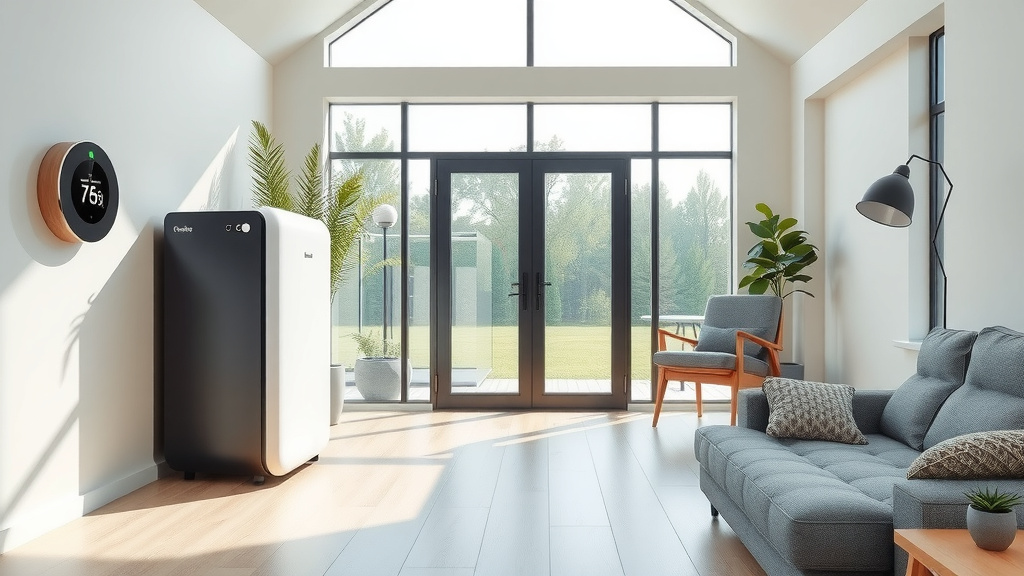
Can Ecobee Control a Standalone Dehumidifier?
No, an Ecobee cannot directly control a standalone dehumidifier. You can use a timer plug for on and off scheduling, but true humidity-based control needs a dehumidifier that accepts a direct control signal.
On this page (9 sections)
- Can Ecobee work with a standalone dehumidifier at all?
- Why can't a thermostat control a portable dehumidifier?
- What can an Ecobee do for humidity without a dehumidifier connection?
- How do you schedule a standalone dehumidifier with a timer plug?
- When does a whole-home dehumidifier make more sense?
- What is the best alternative if you want app control?
- How do you set up a timer plug for a dehumidifier safely?
- What should you check before you buy any timer plug?
- Can a standalone dehumidifier with a timer replace thermostat control?
No, an Ecobee cannot directly control a standalone dehumidifier, because a portable unit has no control terminal for the thermostat to switch it. An Ecobee can show humidity and send alerts, but a timer plug only adds scheduled power, not humidity-based control.
Can Ecobee work with a standalone dehumidifier at all?
No, an Ecobee cannot directly control a standalone dehumidifier, since there is no wire or wireless link between them. The Ecobee shows humidity at the thermostat, while the dehumidifier follows its own panel, and readings can differ by room or height.
You can use both in the same home, checking each reading and adjusting the dehumidifier by hand. Our guide on Can Ecobee Control Dehumidifier? covers the broader question.
A timer plug adds scheduled power only. It cannot start the unit at 55% humidity and stop it at 50%, which is the core limit.
Why can't a thermostat control a portable dehumidifier?
A portable dehumidifier has no input for a thermostat control signal. A thermostat controls equipment through wired terminals or a system built to accept its commands, such as a furnace, air conditioner, or whole-home dehumidifier designed for that link.
A plug-in room unit has only a power cord and its own controls.
The Ecobee is wired into heating and cooling, where it can call for heat, cooling, or fan operation. The standalone dehumidifier sits on its own outlet and responds only to its own controls or to power.
The app can show humidity history and send alerts, but it cannot send a start command.
What can an Ecobee do for humidity without a dehumidifier connection?
An Ecobee can show humidity, track trends, and alert you, but it cannot remove moisture by itself. In cooling mode, some systems dehumidify as a side effect of running the air conditioner.
That depends on equipment, ductwork, and runtime, so it is not a substitute for a dehumidifier in a damp room.
Use the Ecobee reading as a clue, not the full picture. A thermostat is usually on an interior wall at about five feet high, while a basement dehumidifier may sit near the damper floor.
Set the dehumidifier to your target, then watch the Ecobee trend for the whole home. If readings disagree, check placement, runtime, and whether the room unit can handle the load.
How do you schedule a standalone dehumidifier with a timer plug?
A timer plug controls power on and off, so set the dehumidifier to restart on its own when power returns. Put the dehumidifier on a timer, set its humidity target, and let the timer limit run hours.
The dehumidifier still decides whether to run while power is on.
Check two things first. Confirm the dehumidifier restarts as wanted after a power cut, since some units return to standby.
Confirm the timer rating fits the dehumidifier and use a suitable outlet without a power strip in between.
A daily schedule suits predictable dampness, such as after showers. A weekly schedule suits a basement on set days, and neither responds to a sudden spike.
Which digital timer suits daily dehumidifier scheduling?
Choose a digital timer if you want two daily on and off programs with a clear status display. The BN-LINK Indoor 24H Programmable Digital Timer Outlet is a 2-pack with a slim side outlet, so two timers can share one duplex outlet without blocking the second socket.
BN-LINK rates this timer at 125V and 15A, with ON, AUTO, and OFF modes. It offers up to 2 daily repeating programs for a simple once or twice a day schedule.
The built-in backup battery preserves settings for over 3 months after a power interruption or when unplugged. The slim side-outlet design leaves the second half of a duplex outlet usable.
The limit is scheduling depth, since two daily programs cannot cover a complex weekly pattern. The 2-prong non-grounded design suits compatible indoor devices within the rated load.
Which mechanical timer suits a simple daily schedule?
Choose a mechanical timer if you want simple dial setting with no programming and no batteries. The GE 24‑Hour Plug-in Mechanical Timer Outlet is a 2-pack with two grounded outlets, so it can power two three-prong devices from one setup.
GE uses 30-minute interval pushpins on a rotating dial, which you set by hand for a full 24-hour cycle. You can create multiple on and off periods in one day, and a manual override switch pauses the cycle when you need power now.
There is no Wi-Fi, no app, and no battery to maintain.
The two grounded outlets suit a dehumidifier with a three-prong plug. Both outlets run on the same schedule, so you could pair the dehumidifier with a small fan that helps move air across the room.
The trade-off is precision, since 30-minute steps cannot match a one-minute start time.
When does a whole-home dehumidifier make more sense?
A whole-home dehumidifier makes more sense when you want thermostat-based humidity control for the whole house. It connects to your heating and cooling system instead of sitting in one room, with placement, drainage, and airflow handled as part of the system.
The Ecobee reading then reflects a system that can act on it, as the thermostat can call for dehumidification across the ducted space.
Costs and space differ a lot, since a whole-home unit needs space near the air handler, a drain plan, and professional installation in most cases.
A portable unit needs only an outlet and a place to empty or drain the tank, so it may be enough if one basement corner is damp. See connecting whole home dehumidifier to Ecobee and the Best Smart Dehumidifier For Whole House.
What is the best alternative if you want app control?
A dehumidifier with its own app control is the best alternative if you want remote control without a thermostat link. You set humidity, check the tank, and change modes from your phone, without the Ecobee in that loop.
That path suits renters and anyone who cannot modify a heating system. You buy one appliance and place it where the damp air is, with one-space treatment plus tank emptying or drainage as the trade-off.
Check the fine print, since some apps offer full control while others only show status or send alerts. Our guide to the Best Dehumidifier With App Control compares what the app can do.
If you are still deciding whether any dehumidifier is worth it, Do I Really Need a Dehumidifier? and the Best Dehumidifier For Humidity Control roundup are useful next stops.
How do you set up a timer plug for a dehumidifier safely?
Set the dehumidifier to restart automatically, then set the timer hours, then test a full cycle. Plug in the timer, set the humidity target, and confirm it runs when power comes on.
Keep the dehumidifier on a flat, stable surface with vents clear, and route the drain hose or place the tank where you can empty it without tipping the unit.
Match load ratings before you plug anything in, checking that the timer rating covers the dehumidifier and using a grounded outlet where required.
Place a hygrometer near the dehumidifier to judge whether the schedule holds the target, adjusting timer hours first, then the humidity target.
| Timer | Best for | Schedule control | Outlets |
|---|---|---|---|
| BN-LINK Indoor 24H Programmable Digital Timer Outlet | Daily dehumidifier runs in a room with limited outlet space | 2 daily programs, digital display | 1 slim side outlet |
| GE 24‑Hour Plug-in Mechanical Timer Outlet | Simple daily runs with no programming | 30-minute pins, manual override | 2 grounded outlets |
| BN-LINK Outdoor 7-Day Programmable Timer Outlet | Outdoor or garage-adjacent equipment on a weekly pattern | 8 programs, weekly days | 2 grounded outlets |
When would you use the outdoor timer instead?
Use an outdoor timer only if the equipment and outlet are truly outdoors or in a weather-exposed spot. The BN-LINK Outdoor 7-Day Programmable Timer Outlet has a weatherproof cover, two grounded outlets, and up to 8 on and off programs with settings as short as one minute.
BN-LINK rates it at 125V, 60Hz, 15A max, and 1875W resistive or general purpose, with ETL listing. It offers preset day combinations, daylight saving mode, and a random vacation mode that can vary light schedules.
The outlets run at the same time from one setup.
For a dehumidifier, this timer is a niche pick. Most dehumidifiers belong indoors, and indoor moisture is the problem you are solving.
Choose this timer for a fountain, patio lights, or yard equipment on a weekly pattern, not for a basement dehumidifier.
What should you check before you buy any timer plug?
Check load rating, plug type, schedule depth, and restart behavior before you buy. A timer that cannot handle the dehumidifier load or match your schedule will not solve the problem.
Start with the dehumidifier manual for power needs and restart behavior. Match the timer rating to that load and confirm the plug style fits your outlet.
A three-prong dehumidifier needs grounded outlets.
Next, count your schedule needs. Two daily programs suit a simple daily run, eight programs suit a weekly pattern, and 30-minute mechanical pins suit a simple daily cycle.
Finally, test the full setup for one cycle and watch humidity. If air stays damp, add runtime before you add a second unit.
Can a standalone dehumidifier with a timer replace thermostat control?
No, a timer schedule does not replace thermostat control, because it cannot react to humidity changes. It only limits hours with power.
The dehumidifier still runs from its own target and stays off when power is cut, even if humidity spikes.
That limit is fine for predictable dampness. A bathroom that steams after showers or a basement that peaks in the afternoon can follow a set schedule well.
It is a poor fit for leaks, rainstorms, or other sudden moisture.
You get low cost, simple setup, and no changes to your heating system. You give up automatic humidity response, whole-house coverage, and any link to Ecobee readings.
Frequently asked questions
Can Ecobee control a portable dehumidifier?
No, not directly, because a portable unit has no terminal for Ecobee to switch it on or off. An Ecobee can show indoor humidity and send alerts, but the portable unit keeps running by its own controls or by a timer plug schedule.
Can a smart plug let Ecobee control a dehumidifier?
A smart plug can turn power on or off on a schedule, but it cannot read Ecobee humidity data and start the dehumidifier when humidity rises. It only follows the schedule you set in the plug app, so the dehumidifier must also be set to restart automatically after power returns.
What dehumidifier can Ecobee control directly?
A whole-home dehumidifier built to connect to a thermostat can accept a direct control signal from compatible equipment. You need both a dehumidifier with that connection and a thermostat setup that supports it, plus correct wiring at the air handler or dehumidifier.
Is a timer plug safer than leaving a dehumidifier on?
A timer can limit run time, but it does not make an undersized or poorly placed dehumidifier safe. Keep the unit on a stable floor, keep vents clear, empty or drain the tank as directed, and check that the plug and outlet ratings fit the dehumidifier load.