Bathroom Exhaust Fan for Drop Ceiling Guide
A bathroom exhaust fan for drop ceiling use needs a compact housing, a supported mount and a duct path that clears the plenum. Start with the Broan-NuTone 50 CFM model for most small bathrooms, confirm the grid can carry the load, and route ductwork to the nearest exterior vent.
On this page (11 sections)
- How deep must the plenum be for a bathroom exhaust fan for drop ceiling installs?
- How do you support a fan above a drop ceiling grid?
- What clearance does a drop ceiling fan need from ducts, pipes and lights?
- How do you route ductwork from a fan above a suspended ceiling?
- What size bathroom fan do you need under a drop ceiling?
- Can a wall fan or whole house fan handle a bathroom with a drop ceiling?
- How quiet should a bathroom fan be above a drop ceiling?
- Do bathroom fans dehumidify, and how does that affect a drop ceiling?
- How do you replace an old fan when the ceiling is already a drop ceiling?
- What mistakes should you avoid with a bathroom exhaust fan for drop ceiling use?
- How do you finish the install and care for the fan after?
A bathroom exhaust fan for drop ceiling use works best when the fan is supported from above, not from the tiles. For a comparison, see exhaust fans vs ceiling fans.
Pick a compact ceiling-mount fan, add a support frame, and keep the duct run short and clear.
Tiles and grid close the ceiling. They do not carry a vibrating motor and duct load.
You need a separate path for weight and a separate path for air.
Measure the plenum depth where the fan will sit. Plenum depth is the clear space above the tile.
Pipes and low joists can reduce that space in one corner and leave room in another.
Check airflow by room size. The Broan-NuTone model moves 50 CFM and suits a room up to 45 sq ft.
That covers many powder rooms and small full baths, but not a large bathroom on its own.
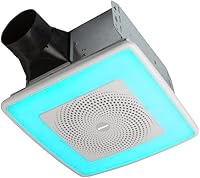
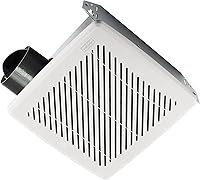
{% raw %}{{product B0F1B4J7BX | A 50 CFM ceiling-mount fan with foldable brackets and a 3 in duct connection for small bathrooms. If its motor needs service, compare bathroom exhaust fan replacement motors.}}{% endraw %}
How deep must the plenum be for a bathroom exhaust fan for drop ceiling installs?
The plenum must be at least as deep as the fan housing plus room for the duct elbow. A fan that fits a flat ceiling may not fit above a tile.
A compact housing helps. The Broan-NuTone housing measures 7-1/4 in by 7-1/2 in by 3-5/8 in.
That height fits a shallow plenum more easily than a deep housing, but you still need space for the duct to turn.
Check the worst point, not the average. A pipe may cross the fan spot at a lower level than the floor above.
Move the fan a few inches if that gives a clear vertical path.
Leave working room too. You need space to set the housing on a support frame, connect the duct, wire the fan and lift the grille into place.
Write down three numbers before you shop: clear depth, distance to the nearest exterior vent, and the location of joists or ducts above.
Firm rule: buy only when the housing height, duct elbow and support frame all fit in the measured plenum.
How do you support a fan above a drop ceiling grid?
A fan above a drop ceiling needs its own support, separate from the tile grid. Use a retrofit support bar or frame tied to the structure above, or a bracket system made for suspended ceilings.
The grid alone is not a safe mount. It is light, it can flex, and it is made to be lifted for access.
A fan adds weight, vibration and a pulling load from the duct.
Look for a housing with foldable mounting brackets, like the Broan-NuTone model. Foldable brackets help you set the housing level between grid members, but check whether your grid spacing matches the housing size.
Tie the support to real structure where you can. Joists, solid blocking or a rated hanger system above the plenum give a steady base.
Do not hang the fan from a sprinkler pipe, a duct or a plumbing line.
Set the housing flush with the tile line. If it sits too high, the grille may not close.
If it sits too low, it can collect dust and look uneven.
Firm rule: the support frame carries the fan, the grid only holds the tile.
What clearance does a drop ceiling fan need from ducts, pipes and lights?
A drop ceiling fan needs clear space around the housing and the duct connection. Keep pipes, ducts and light fixtures out of the fan footprint and out of the duct path.
Start with the housing footprint. The Broan-NuTone cover measures 8-5/8 in by 8-3/8 in, so the tile cutout and parts above it need room for that shape.
A nearby pipe can block the motor or stop the grille from seating.
Next, check the duct elbow. A 3 in duct needs room to bend without a sharp pinch.
A pinched elbow cuts airflow and adds noise. Give it the widest curve the plenum allows.
Watch for heat sources too. Recessed lights and plumbing can run close above a drop ceiling.
Keep the housing away from parts that get hot or need service access.
Mark the area with tape on the tile before you cut. Mark the housing, the duct path and the support bar.
That shows conflicts early, while you can still shift the fan.
Firm rule: if a pipe or duct sits in the fan footprint, move the fan or reroute the pipe, never force the housing in.
How do you route ductwork from a fan above a suspended ceiling?
Route the duct from the fan to the outside by the shortest safe path. Keep the run short, support it, seal the joints and end it at an exterior vent made for bathroom fans.
A drop ceiling gives you a horizontal plenum to work in. That can also hide a long, winding run.
Every extra bend and foot makes the fan work harder. Plan the path on paper before you cut the tile.
Use the duct size the fan calls for. The Broan-NuTone model uses a 3 in duct connection.
Match the duct to that size and support it so it does not sag.
Do not end the duct in the plenum. Moist air dumped above a drop ceiling will feed mould on the tile back and grid.
It can also stain tiles and drip through. The air must leave the building.
If the nearest exterior wall is far, think about the path early. You may need to cross joists or pass through a soffit.
Our guide to how to add exhaust fan to bathroom covers adding a fan where none exists yet.
Firm rule: no exterior vent, no fan install, because the plenum is not a vent.
What size bathroom fan do you need under a drop ceiling?
Size the fan by room area, not by ceiling type. A 50 CFM fan suits a small room up to 45 sq ft, so larger bathrooms need a larger or different solution.
The Broan-NuTone 50 CFM model suits a powder room or small full bath. For lower-noise options, see quiet bathroom exhaust fans.
It removes moisture and odour from that size of room, and it runs at 2.0 sones.
Low sound matters in a small, hard-surfaced room.
For a larger room, start with a proper sizing check. Our guide on what size bathroom fan helps you work out airflow from room dimensions.
A large bathroom or a room with a tub and separate shower may need more than 50 CFM.
Ceiling type does not change the math, but it changes your options. A drop ceiling may limit you to compact housings.
If a bigger fan will not fit the plenum, you may need two smaller fans or a different vent path.
Think about use as well as size. A fan that is too small will run longer and still leave moisture behind.
A fan that is far too large can cost more, make more noise and pull in drafts.
Firm rule: match CFM to room area first, then check that the housing fits the plenum.
Can a wall fan or whole house fan handle a bathroom with a drop ceiling?
A wall fan or whole house fan can help a large space, but neither replaces a bathroom fan in most drop ceiling bathrooms. Use a bathroom fan for spot moisture, and use larger fans only for the spaces they are built for.
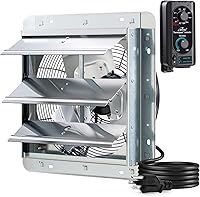
The iLiving 12 in wall mounted shutter exhaust fan moves 960 CFM and covers up to 1,400 sq ft. It has an automatic shutter, a thermostat and variable speed control.
That scale suits a garage, workshop or warehouse, not a small bathroom.
{% raw %}{{product B08FF9Q5JH | A 12 in wall fan at 960 CFM for garages and workshops, not for a small bathroom ceiling.}}{% endraw %}
The Quietcool QC CL-4700 RF moves up to 4,415 CFM on high and covers up to 2,208 sq ft. It hangs from attic rafters with a ceiling cut-out of 14 in by 30 in.
That is whole house ventilation, not a bathroom spot fan.
{% raw %}{{product B0DQ421TFN | A whole house fan at up to 4,415 CFM for cooling large homes, not for a bathroom drop ceiling.}}{% endraw %}
More CFM is not better for every room. A bathroom needs focused removal at the source, with a duct to the outside.
A whole house fan pulls air through open windows and out attic vents. It does not spot-vent a shower.
If your bathroom has a window, see our best bathroom exhaust fan for window picks. If you prefer a plug-in unit, see our best bathroom exhaust fan plug in picks.
Neither solves a drop ceiling mount on its own.
Firm rule: a bathroom with a shower needs a ducted bathroom fan, not a whole house fan.
How quiet should a bathroom fan be above a drop ceiling?
A bathroom fan above a drop ceiling should be quiet enough for the room size. Look for low sones ratings, a solid support frame and a duct that does not hum or rattle.
The Broan-NuTone model runs at 2.0 sones. That is low for a small bathroom, and it helps the fan feel calm rather than harsh.
In a powder room, the fan is close to your ear.
Sound also comes from the mount. A fan that sits loose on a grid can buzz.
A support frame that is tight and level cuts that risk. So does a duct that is supported and sealed, instead of resting on the tile.
Avoid a fan far larger than the room needs. Excess CFM often brings excess noise.
If you need more airflow, check the sound rating at the same time.
Test the grille fit before you finish. A grille that clicks in firmly will not flutter.
A grille that sits flat will not whistle at the edges. Tiles can act like a sounding board, so small fits matter.
Firm rule: choose low sones for small rooms and fix the mount before you blame the motor.
Do bathroom fans dehumidify, and how does that affect a drop ceiling?
Bathroom fans remove moist air, but they do not act like a dehumidifier for the whole house. They help most when they run after a shower or bath and vent the moisture outside.
Our explainer on Do Bathroom Fans Dehumidify? covers that point in more detail. The fan pulls room air out through the duct.
Fresh air enters from the room or hallway. That exchange lowers humidity fastest when the fan runs after moisture is made.
With a drop ceiling, the stakes are higher. Moist air that stays in the room can settle on tiles and grid.
Moist air that leaks into the plenum can cause mould where you cannot see it.
Size and run time work together. A 50 CFM fan in a 45 sq ft room can do the job if it runs after each use.
The same fan in a larger room may need a longer run or a larger model.
Do not use a dehumidifier as a substitute for venting. A dehumidifier collects water in a tank and still needs power and emptying.
Our post on Does a Dehumidifier Need an Exhaust? explains when a dehumidifier needs a vent. For a bathroom, the fan is the direct fix.
Firm rule: run the fan during and after showers, and vent outside, because tiles hide mould well.
How do you replace an old fan when the ceiling is already a drop ceiling?
Replacing an old fan in a drop ceiling starts with the old housing size and the duct path. Measure the old cutout, check the support above and confirm the new housing fits before you remove anything.
Lift out the tile section first and look above. Note the support, the duct connection and any wiring.
If the old fan was hung from the grid, plan a proper support frame for the new one.
Check whether the old duct still goes outside. Old ducts can disconnect, crush or vent into the plenum over time.
If the duct ends above the ceiling, fix that before you fit a new fan.
Compare the Broan-NuTone housing with the old cutout. Its housing is 7-1/4 in by 7-1/2 in by 3-5/8 in, with an 8-5/8 in by 8-3/8 in cover.
If the old cutout is smaller, you may need to trim a tile. If it is larger, check that the cover hides the gap.
Our step guide on how to replace a bathroom exhaust fan walks through the full swap. Use it alongside your drop ceiling checks, because support and plenum steps differ most from a flat ceiling.
Firm rule: fix the support and the duct first, then fit the new fan.
What mistakes should you avoid with a bathroom exhaust fan for drop ceiling use?
The biggest mistakes are hanging the fan from the grid, venting into the plenum and buying by CFM alone. Avoid those three, and most drop ceiling fan problems go away.
Hanging from the grid is first. Tiles flex, grids shift and fans vibrate.
A support bar above the tiles fixes the load in the right place. It also keeps the grille level, so the fan looks clean and seals well.
Venting into the plenum is second. That puts warm, moist air on the back of tiles and on metal grid parts.
Mould can grow out of sight, and stains can show through the tile face.
Buying by CFM alone is third. A 960 CFM wall fan and a 4,415 CFM whole house fan are powerful, but they do not fit a small bathroom ceiling.
The Broan-NuTone 50 CFM fan fits because its size, housing and sound level match a small room.
Other errors include pinching the duct elbow and cutting the tile before marking the support. Mark the plan on the tile, route the duct with care and support it along the way.
{% raw %}{{product B0F1B4J7BX | A compact 50 CFM fan with foldable brackets, for small bathrooms where the plenum is shallow.}}{% endraw %}
Firm rule: support from above, vent outside and size for the room, never for the ceiling alone.
How do you finish the install and care for the fan after?
Finish the install by checking the seal, the grille fit and the airflow path. Run the fan, check that air moves, and keep the grille and fan parts clean.
Set the grille last. The Broan-NuTone grille cover removes with springs, so check that both sides seat evenly.
A grille that sits flat will look right and will not buzz.
Check the duct joints from above if you can reach them. A loose joint can leak moist air into the plenum.
Seal and support each joint, then confirm the exterior vent opens when the fan runs.
For care, remove the grille on a regular schedule and vacuum dust from the grille and housing. Wipe the motor area only as the maker directs.
Do not spray water into the fan.
Listen for changes. New rattles often mean a loose support, a loose grille or a duct that shifted.
A drop in airflow can mean a blocked vent or a pinched duct. Fix those small issues early.
Final rule: pick the Broan-NuTone 50 CFM fan for a small bathroom, support it from above, vent outside and size up only when the room asks for it.
Frequently asked questions
Can I mount a bathroom exhaust fan in a drop ceiling?
Yes, if the housing fits the plenum depth and the grid or a support frame carries the fan weight. Use a support bar or retrofit frame above the tiles, keep the duct connection clear of the ceiling grid, and vent outside.
Do not let the fan hang from a tile alone.
How deep is the space above a drop ceiling?
Many drop ceilings have only a few inches between the tile and the floor or joists above. Measure from the bottom of the tile to the lowest duct, pipe or joist in that exact spot.
Then compare that depth with the housing height and the duct elbow before you buy.
What size fan do I need for a bathroom with a drop ceiling?
Size the fan by room area and moisture load, not by ceiling type. The Broan-NuTone 50 CFM model suits a room up to 45 sq ft, so check what size bathroom fan you need for larger rooms.
A bigger room or a full bath with a tub or shower may need more airflow.
Where should a bathroom fan duct go with a suspended ceiling?
Route the duct through the plenum to the shortest safe path outside, ideally through a nearby wall, soffit or roof vent made for this use. Keep the run short, support it so it does not sag, and seal joints.
Never vent into the plenum or attic above a drop ceiling.