Types of Humidifiers: Pros, Cons, and How to Choose
The best humidifier type depends on your room, noise tolerance and cleaning routine. Evaporative models suit larger spaces, ultrasonic units run quietly, and steam models add heated moisture.
On this page (8 sections)
- What are the main types of humidifiers?
- Which humidifier type is best for a bedroom?
- Which type is best for a large room?
- How do you choose between cool mist and warm mist?
- How does water quality change the choice?
- How much maintenance does each type need?
- What humidity level should you aim for?
- Which type of humidifier should you choose?
The best humidifier type depends on your room size, noise tolerance, water quality and willingness to clean it. Evaporative models suit larger spaces, ultrasonic units are often quieter, and steam vaporizers add heated moisture.
Noise matters more in a bedroom or home office. A fan based unit may be fine in a living room, but the same sound can be distracting at night.
Water quality also changes the routine. Hard tap water can leave mineral dust with some designs, while other designs hold minerals in a wick or scale inside a chamber.
Every humidifier adds water to indoor air, but each method handles water differently. The main choices are evaporative, ultrasonic, steam, whole-house and impeller humidifiers.
An evaporative model uses a wick to pull water up and a fan to move air through it. An ultrasonic model uses vibration to turn water into a fine mist, often without a fan.
A steam vaporizer heats water and releases warm moisture, but that heat adds a burn risk and a need for safe placement. Impeller models use a rotating disk to create droplets and are less common.
Whole-house humidifiers serve more than one room and may connect to heating or cooling equipment. They usually need more planning than a portable unit.
Before choosing, check our best air humidifiers for home guide for room-size and feature comparisons. You can also learn more about do humidifiers work if you are unsure whether added moisture fits your home.
Room size should be the first filter. A model that is too small may run all day with little effect, while an oversized unit can push humidity too high in a closed space.
Cleaning habits matter just as much as features. Choose a unit you can empty, rinse and dry, and place it on a stable surface with room for air flow, away from walls, bedding and electronics.
What are the main types of humidifiers?
The main humidifier types are evaporative, ultrasonic, steam, impeller and whole-house systems. Evaporative and ultrasonic models are the most common portable choices, while whole-house systems serve a different installation need.
Evaporative humidifiers
Evaporative humidifiers use a wick, filter or other absorbent material to draw in water. A fan moves air through the damp material, and the moisture enters the room as vapor.
Pros:
- Often suitable for bedrooms, living rooms and larger open areas
- Natural evaporation can limit how much moisture enters the air
- Many models include a humidistat or automatic shutoff
- Mineral deposits may collect in the wick instead of spreading through the room
Cons:
- Fan noise can be noticeable
- Wicks need cleaning or replacement
- A damp filter can smell if it isn't changed on schedule
- The fan and wick add parts that need regular care
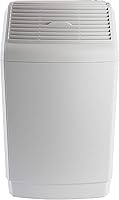
The AIRCARE Space Saver Large Evaporative Whole House has a 6-gallon capacity, a 1043 Super Wick, digital controls, an auto humidistat and automatic shutoff when the desired humidity is reached or the unit is empty.
Ultrasonic humidifiers
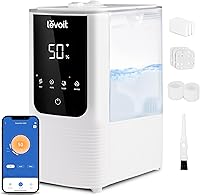
Ultrasonic humidifiers use a vibrating plate to break water into a fine mist. They usually operate without the fan found in evaporative models, which can make them a good fit for quiet rooms.
Pros:
- Often quieter than fan-based humidifiers
- Compact models fit bedrooms, desks and smaller rooms
- Can use less power than a heated humidifier
- No wick is needed
Cons:
- Minerals in tap water can become white dust on nearby surfaces
- The water tank and vibrating plate need frequent cleaning
- A mist outlet can wet furniture if the unit is placed poorly
- Some models need distilled or low-mineral water for cleaner operation
Ultrasonic models make sense when quiet operation is your first priority. Read our evaporative humidifier vs ultrasonic comparison for a closer look at noise, mineral control and maintenance.
Steam vaporizers
Steam vaporizers heat water until it becomes steam, then release the moisture into the room. The heating process can reduce some microbes in the water, but the appliance and output can become hot.
Pros:
- Adds warm moisture instead of a cool mist
- Useful for people who prefer heated output
- Does not rely on a wick or high-speed fan
- Can suit a small room when placed safely
Cons:
- Uses a heating element
- Hot water and steam create a burn risk
- Mineral scale can build up inside the heating chamber
- It may not be suitable around young children or pets
A steam vaporizer is not the same as every cool-mist humidifier. Compare the safety and use differences in our vaporizer vs humidifier for adults guide.
Impeller humidifiers
Impeller humidifiers use a rotating disk to throw water against a diffuser. The diffuser breaks the water into fine droplets that leave the unit as a cool mist.
Pros:
- Produces cool mist
- Does not need a heating element
- Can be simple to operate
- Often works well in small rooms
Cons:
- May spread minerals from tap water
- Requires regular cleaning
- Can over-humidify a small space if left unattended
- Impeller models are less common than evaporative and ultrasonic units
The same moisture-control rules apply here: use a humidity monitor, keep the unit away from walls and electronics, and empty standing water when the humidifier is not in use.
Whole-house humidifiers
Whole-house humidifiers are designed to add moisture across multiple rooms, often through a home's heating and air-conditioning system. For a furnace-specific example, see humidifier types for a Lennox furnace.
They can use a bypass, fan-powered or steam-based design.
Pros:
- Can serve more than one room
- Reduces the need to refill several portable tanks
- May connect to a central humidity control
- Keeps equipment off bedroom floors and furniture
Cons:
- Usually needs professional installation
- Costs more to install than a portable unit
- Requires maintenance inside the HVAC system
- Performance depends on ductwork, airflow and home layout
Choose a whole-house system when several rooms need humidity and you want a permanent setup. A portable humidifier is simpler when only one bedroom, office or living area needs moisture.
Which humidifier type is best for a bedroom?
An ultrasonic humidifier is often best for a bedroom when quiet operation matters, while a small evaporative model is a better fit if you prefer wick-based moisture control.
A bedroom is usually a closed door space, so sound carries more than in an open living area. That is why a fan-free ultrasonic design often feels easier to live with at night.
Quiet is not the only concern. Mist direction, tank cleaning and water type can affect how pleasant the unit is to own.
Place any humidifier on a stable, water-resistant surface with room for air to move around it. Aim the mist away from bedding, walls, windows and electronics and keep it a few feet from the bed when you can.
Direct mist on pillows or blankets can leave fabric damp and make the room feel clammy rather than fresh. Check for condensation each morning.
If windows stay fogged or walls feel damp, the setting is too high or the unit runs too long.
Automatic shutoff can help prevent the tank from running dry. A built-in humidistat can stop or reduce operation after the room reaches its target humidity.
Do not choose only by tank size. A large tank reduces refills, but it holds more standing water if you do not empty and clean it regularly.
For a small bedroom, a compact tank you refill often may suit you better. Regular refilling gives you a chance to rinse the tank and start with clean water.
A small evaporative model can also work if you dislike mist, but fan sound is the main trade-off. Pick a model you will actually rinse and dry each week, as that habit matters more than a long list of extra features.
Which type is best for a large room?
An evaporative console humidifier is often the strongest match for a large room because it combines a water reservoir, wick and fan to move moisture through a bigger area. Confirm the stated coverage before you buy.
A large room needs air movement, not just a large tank. The fan helps carry moisture away from the unit and across open space.
Coverage claims are a guide, not a promise. Ceiling height, furniture, doorways and heating vents can all change how far moisture spreads.
The AIRCARE Space Saver is designed for up to 2,700 sq ft and includes casters, digital touch controls and an auto humidistat. Those features may help in an open living area, but results depend on layout and airflow.
Its 6-gallon capacity means fewer refills during long dry spells. That can suit a living room, office or bedroom suite where you do not want to carry a small tank every few hours.
The included 1043 Super Wick draws water up for evaporation. In daily use, it will need cleaning or replacement on schedule, so plan for that cost and effort.
Casters can help you move the unit for cleaning or shift it when furniture changes. They do not solve placement by themselves, so keep it away from walls and wood floors.
Digital controls and an auto humidistat make it easier to set a target and let the unit cycle. That is useful where guessing humidity from comfort alone is unreliable.
Evaporative designs can suit hard water because minerals may collect in the wick. The trade-off is fan noise and a filter that can smell if it stays damp too long.
Place the unit where air can circulate and where a leak would not cause damage. Do not expect one console unit in a living area to treat closed bedrooms at the same level.
An air purifier does not replace a humidifier. The Levoit Core 300-P filters airborne particles and includes Sleep Mode, but it does not add moisture.
How do you choose between cool mist and warm mist?
Choose cool mist when you want lower heat risk, and choose warm mist when you specifically prefer heated moisture and can place the unit safely. Both types still need cleaning and humidity control.
Cool mist includes evaporative, ultrasonic and impeller designs. Warm mist generally refers to steam vaporizers and similar heated models.
For a bedroom or family room, cool mist can be easier to place around children and pets because it does not release hot steam. For an adult's private room, a steam model may suit you if you can keep it stable and out of reach.
Warm mist also does not make a humidifier maintenance-free. Scale, stagnant water and dirty parts can still affect operation.
How does water quality change the choice?
Water quality matters most with ultrasonic and impeller humidifiers because minerals can leave the tank as part of the mist. If your tap water is hard, an evaporative humidifier may be easier to manage because minerals can collect in its wick.
Use the water type recommended for your model. If you see white dust, crust around the tank or a change in mist output, stop and clean the unit before continuing.
Never let water sit in the tank for long periods. Empty unused water, rinse the tank and allow parts to dry before refilling.
A small air purifier can help with airborne particles, but it does not remove the need to control mineral buildup at the humidifier itself.
How much maintenance does each type need?
Every humidifier needs regular emptying, cleaning and drying, but the parts that need attention differ by type.
| Humidifier type | Main maintenance task | Common concern |
|---|---|---|
| Evaporative | Clean or replace the wick | Fan noise and damp filter odor |
| Ultrasonic | Clean the tank and vibrating plate | Mineral dust from hard water |
| Steam | Descale the heating chamber | Hot water and steam |
| Impeller | Clean the tank and rotating disk | Mineral buildup in the mist path |
| Whole-house | Maintain the water panel or internal parts | Installation and HVAC access |
Follow the manual's cleaning instructions and disconnect power before servicing. Do not mix cleaning chemicals, and rinse parts well before returning them to use.
Cleaning is where humidifier types differ most in daily life. Evaporative models need wick care, ultrasonic models need tank and plate care, and steam models need descaling.
Empty the tank when you are not using the unit. Rinse it, wipe accessible surfaces and let parts dry before you store or refill it.
Do not let a wick sit in dirty water for weeks. A damp wick that is not cleaned or replaced can develop an odor that the fan then spreads through the room.
For ultrasonic models, check for crust or slime and clean the vibrating plate as directed. Mineral buildup can change mist output and leave dust on nearby surfaces.
Steam models need safe handling with hot water. Let the chamber cool before you move it, and keep the cord and steam outlet away from children and pets.
Keep humidity moderate rather than running a humidifier continuously. Too much moisture can create condensation on windows and dampen nearby surfaces.
A simple weekly routine is easier to keep than a deep clean after problems start. Empty, rinse, dry and refill with fresh water when the manual calls for it.
What humidity level should you aim for?
Aim for a moderate indoor humidity level and reduce operation if you see condensation on windows, walls or furniture. A separate humidity meter shows room conditions more clearly than comfort alone.
Comfort is a clue, but not a reliable meter. Air can feel dry because of temperature, air flow or a recent shower, even when the reading is already moderate.
Place the meter away from the humidifier for a fairer picture. Put it in the middle of the room at seating or sleeping height, not right beside the mist outlet.
The right setting varies with outdoor temperature, insulation, ventilation and moisture sources in the room. Check bedrooms, bathrooms and basements separately if they behave differently.
Winter heating can dry indoor air, but a bathroom may stay damp after showers. A basement can behave differently again, especially with water entering through the floor or walls.
That is why one setting for the whole home rarely fits every room. Use the humidifier where the air is dry and reassess other spaces on their own terms.
Reduce output when you see condensation. That sign usually means the room is getting more moisture than surfaces can handle.
Repeated dampness can stain paint, swell wood and create conditions where mold can grow. It is not just a comfort issue.
If the home already feels damp, a humidifier is the wrong tool. Read Does Air Con Dehumidify? to understand how cooling systems may affect moisture, and see Do I Need a Dehumidifier and a Humidifier? when different rooms need different solutions.
A damp room may need better ventilation, a dehumidifier or a leak repair instead of more moisture. Adding a humidifier can make the problem worse.
Start with the meter, then adjust in small steps. Run the unit for a period, check the reading, and change the setting only when the trend is clear.
When the air is already moderate, pausing the humidifier is often best. Saving the tank for a truly dry spell gives the room a chance to dry out.
Which type of humidifier should you choose?
Choose an evaporative humidifier for larger rooms, wick-based moisture control and a built-in fan. Choose an ultrasonic model for quiet bedroom use, but plan for careful cleaning and possible mineral dust.
Pick a steam vaporizer if warm moisture matters and you can manage hot surfaces safely. Choose an impeller model only if its cool-mist design and maintenance routine fit your room.
For several rooms, consider a whole-house system after checking installation needs and ductwork. For one room, a portable unit is usually easier to place, clean and replace.
The best choice is the model you can safely position and maintain. Match the humidifier to your room, water quality and cleaning routine, then use a humidity monitor to keep moisture from getting out of hand.
Frequently asked questions
What type of humidifier is best for most homes?
An evaporative humidifier is a practical choice for many homes because a wick absorbs water and a fan moves air through it. Choose an ultrasonic model if quiet operation matters most, or a steam vaporizer if you specifically want heated moisture.
Room size and cleaning habits should guide the final choice.
Are ultrasonic humidifiers better than evaporative humidifiers?
Ultrasonic humidifiers are quieter and often use less power because they vibrate water into a fine mist instead of using a fan. Evaporative models can be easier to manage with mineral-heavy water because the wick captures some minerals.
Neither type is best for every room or maintenance routine.
Which humidifier type is easiest to maintain?
The easiest humidifier to maintain is the one you can empty, clean and dry regularly. Evaporative models need wick replacement, while ultrasonic units need careful cleaning to limit mineral buildup.
Steam models avoid cool mist but still need descaling and safe handling around hot water.
Do humidifiers use a lot of electricity?
Electricity use depends on the humidifier type, fan, heater and operating time. Ultrasonic and evaporative models generally avoid the heating element used by steam vaporizers.
Check the unit's power information and use a humidistat or automatic shutoff when available to avoid unnecessary operation.
Can one humidifier cover a whole house?
A portable humidifier usually serves one room or an open area, even when its stated coverage is large. Whole-house coverage normally requires a larger console unit or a system connected to the home's ductwork.
Keep doors, airflow and the home's layout in mind when judging coverage.